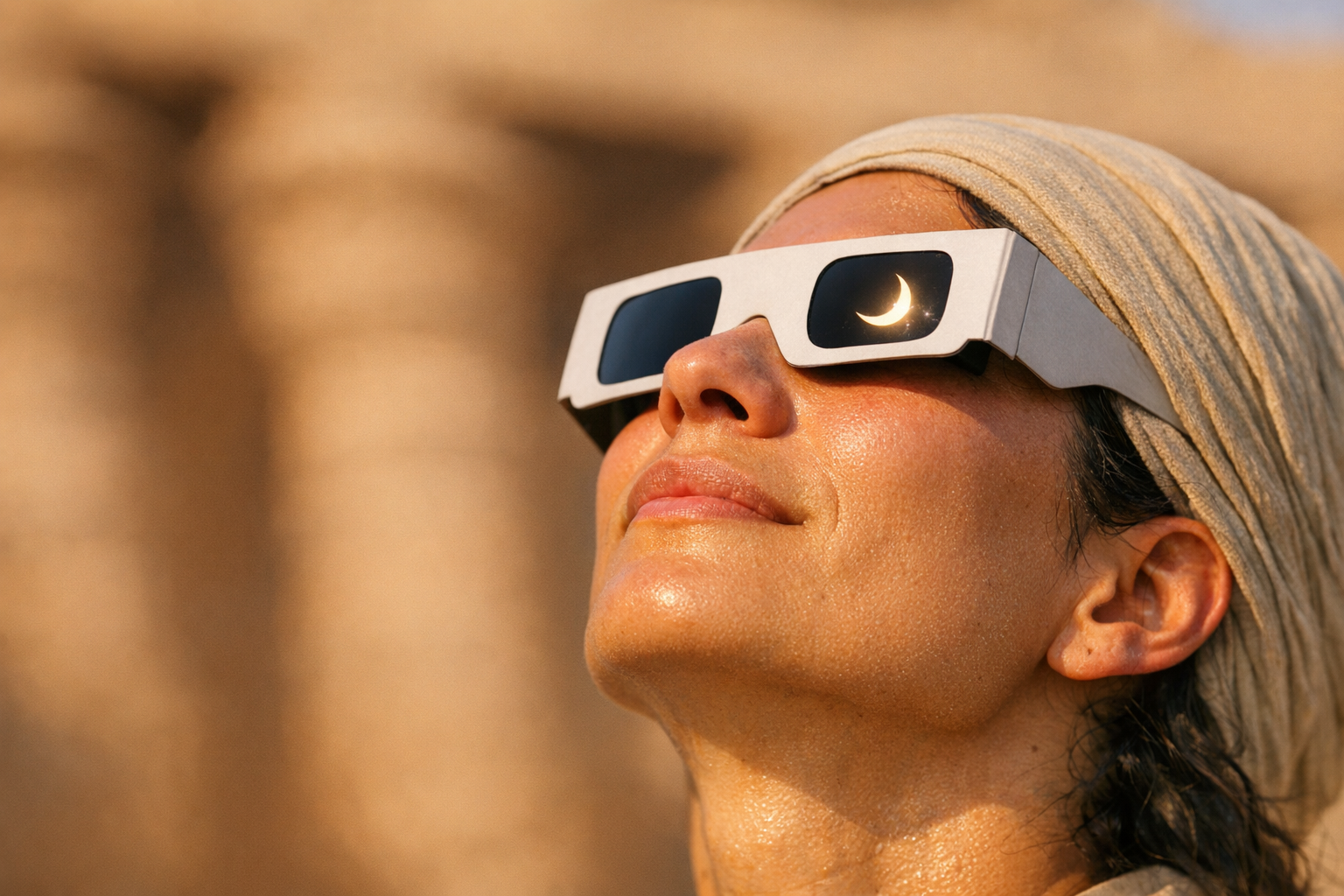
To watch the total solar eclipse of 2 August 2027 in Egypt safely, wear ISO 12312-2 certified eclipse glasses during every partial phase, and take them off only during totality itself — putting them straight back on the instant the first bright bead of sunlight returns.
That single rule covers almost everything you need to know. The rest is preparation. Monday 2 August 2027 will be one of the hottest and busiest days Luxor has ever seen, and a little planning turns a stressful afternoon into six minutes you will never forget.
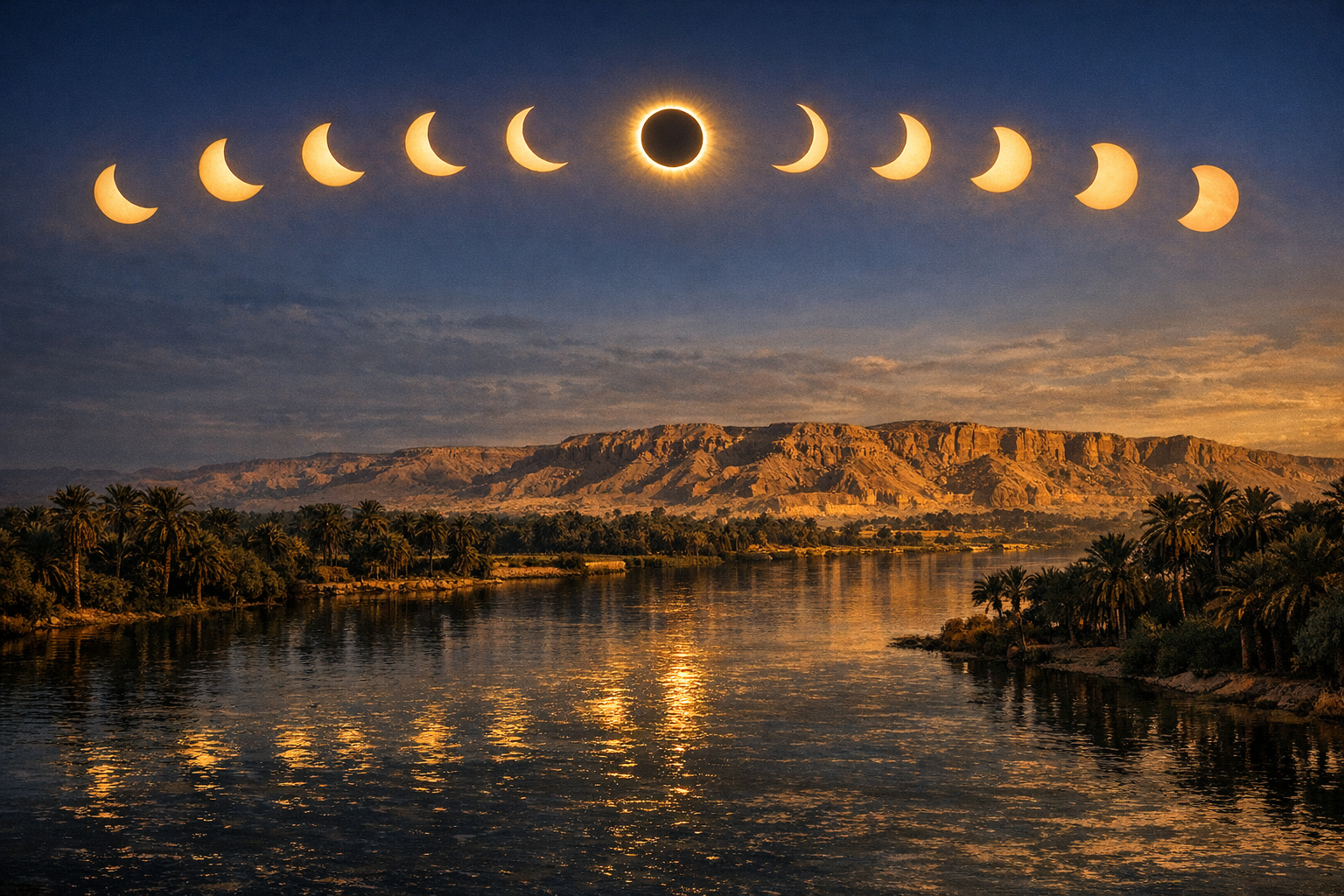
In Luxor the partial phases run from 11:40 to 14:26. Totality begins at 13:02:14, reaches maximum eclipse at 13:05:26 and ends at 13:08:36 — 6 minutes and 22 seconds of darkness. If you want the background on why Luxor sits in such a privileged position, read our full guide to the 2027 total solar eclipse in Egypt.
Never look at the partially eclipsed sun unprotected
During the partial phases the sun is still blindingly bright, even when it has been reduced to a thin crescent. Permanent retinal damage can happen in seconds, and it is painless, so you will not feel it happening. Never look at the partially eclipsed sun through any of the following:
- Your naked eye
- Ordinary sunglasses, however dark, or several pairs stacked together
- Smoked glass, exposed photographic film or old negatives
- A phone screen or a camera viewfinder
- Binoculars or a telescope without a purpose-made solar filter fitted over the front of the lens
Binoculars and telescopes are the most dangerous of all: they concentrate sunlight, can cause injury almost instantly, and will burn straight through eclipse glasses held behind them.
Use certified glasses — and check them first
Only use glasses certified to the ISO 12312-2 international standard. Before eclipse day, hold each pair up to a bright indoor lamp: you should see nothing at all, or only the faintest glow.
- Inspect every pair for scratches, pinholes, creases or separation from the frame
- Throw away any damaged pair rather than risk it
- Put the glasses on before you look up, and turn away from the sun before taking them off
- Supervise children at all times — fit their glasses yourself and check them between phases
The one moment you can look without a filter
Totality is the only safe exception. Once the sun's disc is completely covered by the moon, the glasses come off and you look directly at the corona with your own eyes — this is the whole reason for travelling to the centre line. The instant the first bright bead of sunlight reappears at the edge of the moon, the glasses go back on and stay on. Do not wait to be told: if the sky begins to brighten, cover your eyes.
Phones, cameras and the six-minute temptation
During the partial phases, any camera or phone pointed at the sun needs a proper solar filter over the front of the lens — and the sensor can be damaged as easily as your eyes. During totality, and only during totality, you can shoot unfiltered.
Honestly, though, 6 minutes and 22 seconds passes faster than you expect. Set a phone on a small tripod, press record, and then spend the rest of the time actually watching. Professional images of this eclipse will exist in their thousands; your memory of it will not.
Heat safety at 42°C
August highs in Luxor average around 42°C, under the very clear skies that make it such a good eclipse site in the first place. Heat, not the eclipse, is the most likely thing to spoil your day.
- Carry at least three to four litres of water per person for the day
- Add electrolyte or rehydration salts — water alone is not enough in this heat
- Wear light, loose, long-sleeved clothing and a wide-brimmed hat
- Apply high-factor sunscreen and reapply through the morning
- Stay in shade during the long partial phases and step out to watch
- Avoid standing on unshaded sand or stone for hours before totality
Eclipse day packing checklist
- ISO 12312-2 certified eclipse glasses — one checked pair per person, plus a spare
- A solar filter for any camera or binoculars you plan to use
- Three to four litres of water per person, plus electrolyte sachets
- Wide-brimmed hat, ordinary sunglasses for normal daylight, high-factor sunscreen
- A light long-sleeved shirt and comfortable closed shoes
- Fully charged phone and a power bank
- Cash in small notes
- A folding chair or mat, and a light scarf or umbrella for portable shade
- Snacks and a small first-aid kit with rehydration salts
Arrive early and scout your spot
Roads, transfers and airports around Luxor will be congested in the days around the eclipse. Arrive one or two days early rather than travelling on the morning of 2 August, and treat eclipse day itself as a day with a single appointment in it.
- Visit your viewing position the day before, at the same time of day, and see where the shade falls
- Confirm how long the transfer takes, then allow far more time than that
- Charge every device the night before
- Carry cash; card payments and mobile signal may both struggle in the crowds
Timings shift by a few minutes depending on where you stand, so check our eclipse times for cities across Egypt before you commit to a location.
What to watch for during the six minutes
- A noticeable drop in temperature and a sudden stillness in the air
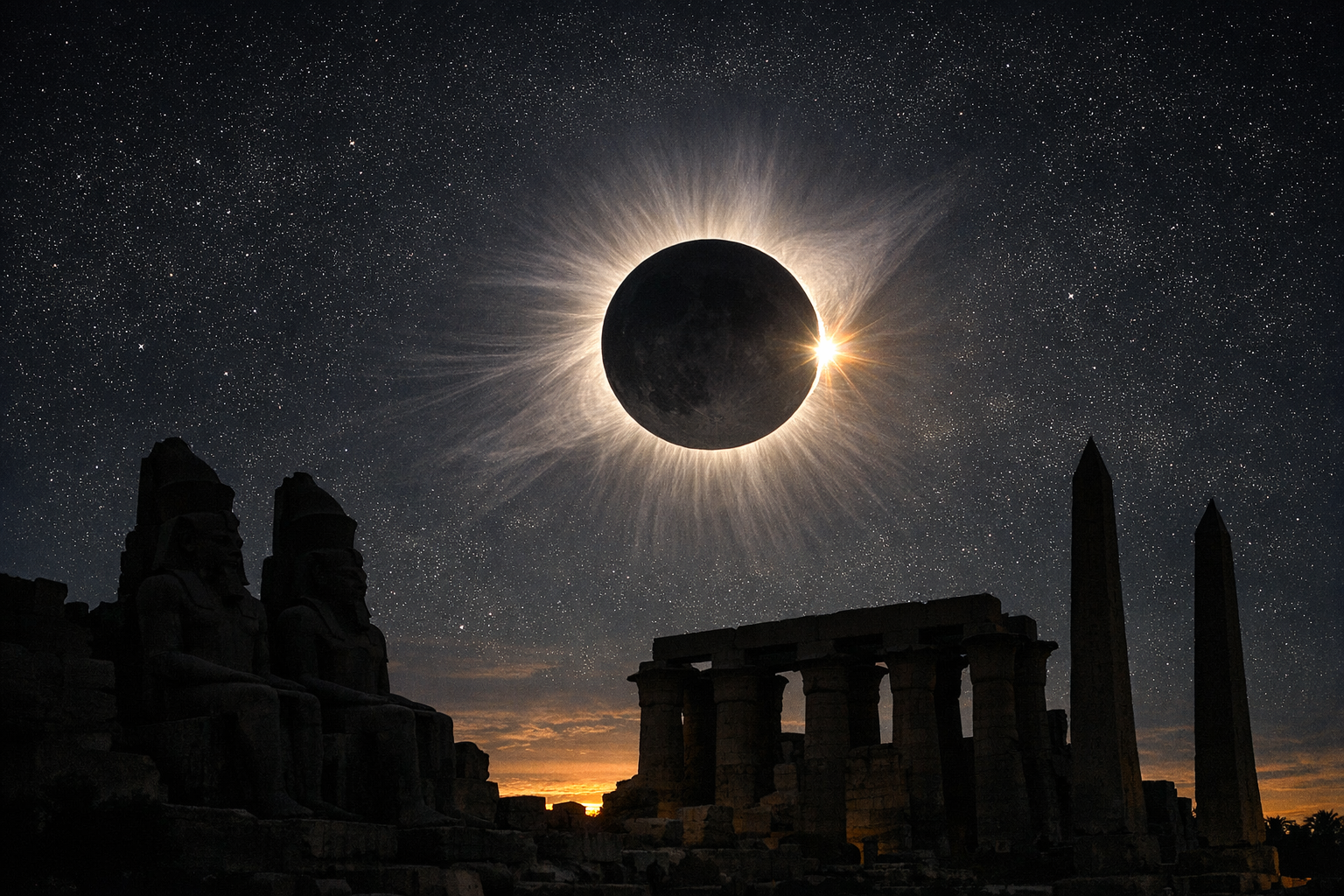
- Baily's beads — points of sunlight shining through valleys on the moon's edge — followed by the diamond ring as the last one fades
- The pearly white corona streaming out around the black disc of the moon
- A 360-degree sunset glow all the way around the horizon
- Bright planets and stars appearing in the middle of the afternoon
- The diamond ring and Baily's beads again as totality ends — glasses back on
Glasses, shade and water with FreeGo
FreeGo provides ISO 12312-2 certified eclipse glasses for every guest on its 2027 eclipse tours, along with shaded viewing positions reserved in advance and plenty of drinking water through the day. If you are still deciding where to watch from, get in touch and we will help you plan it.