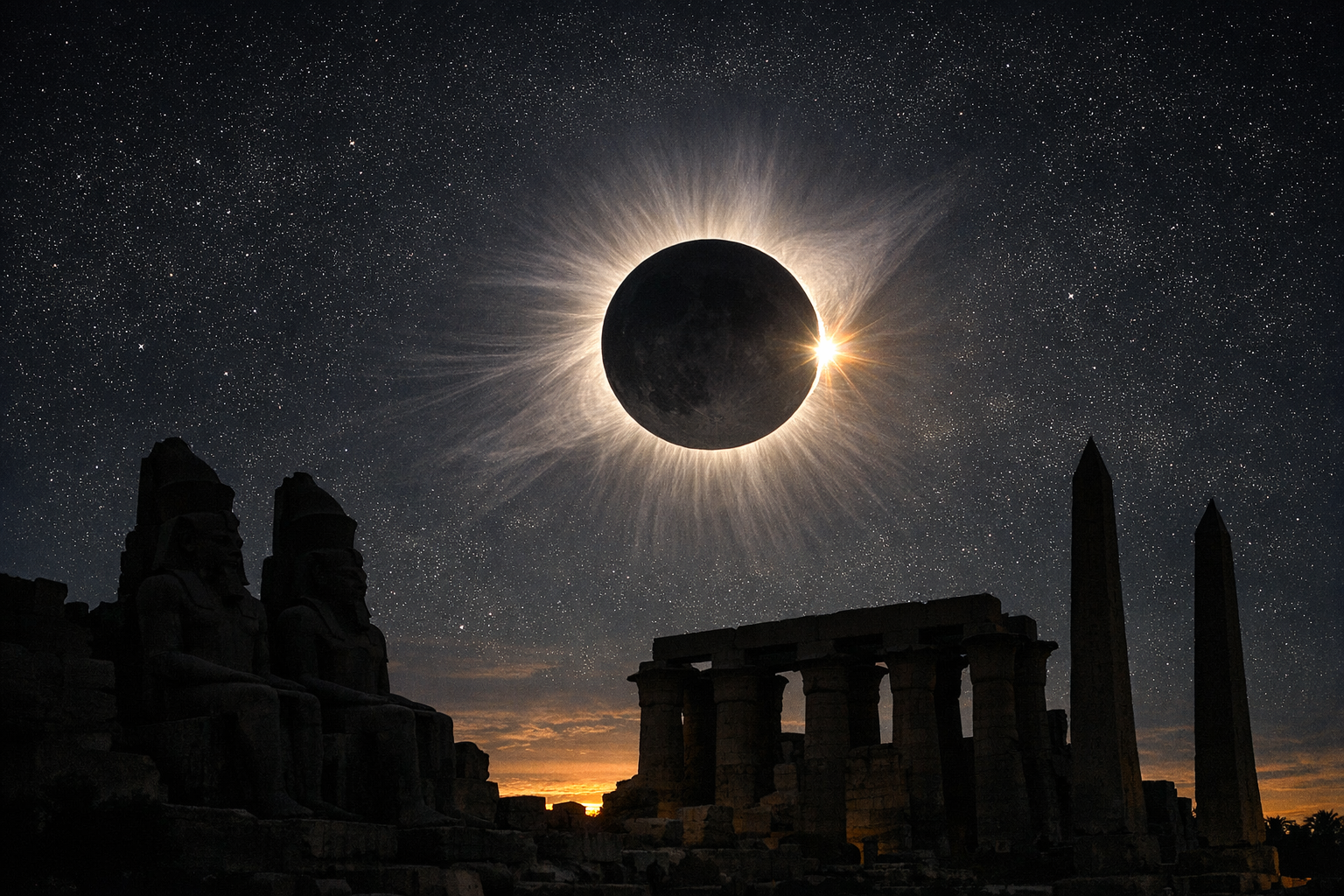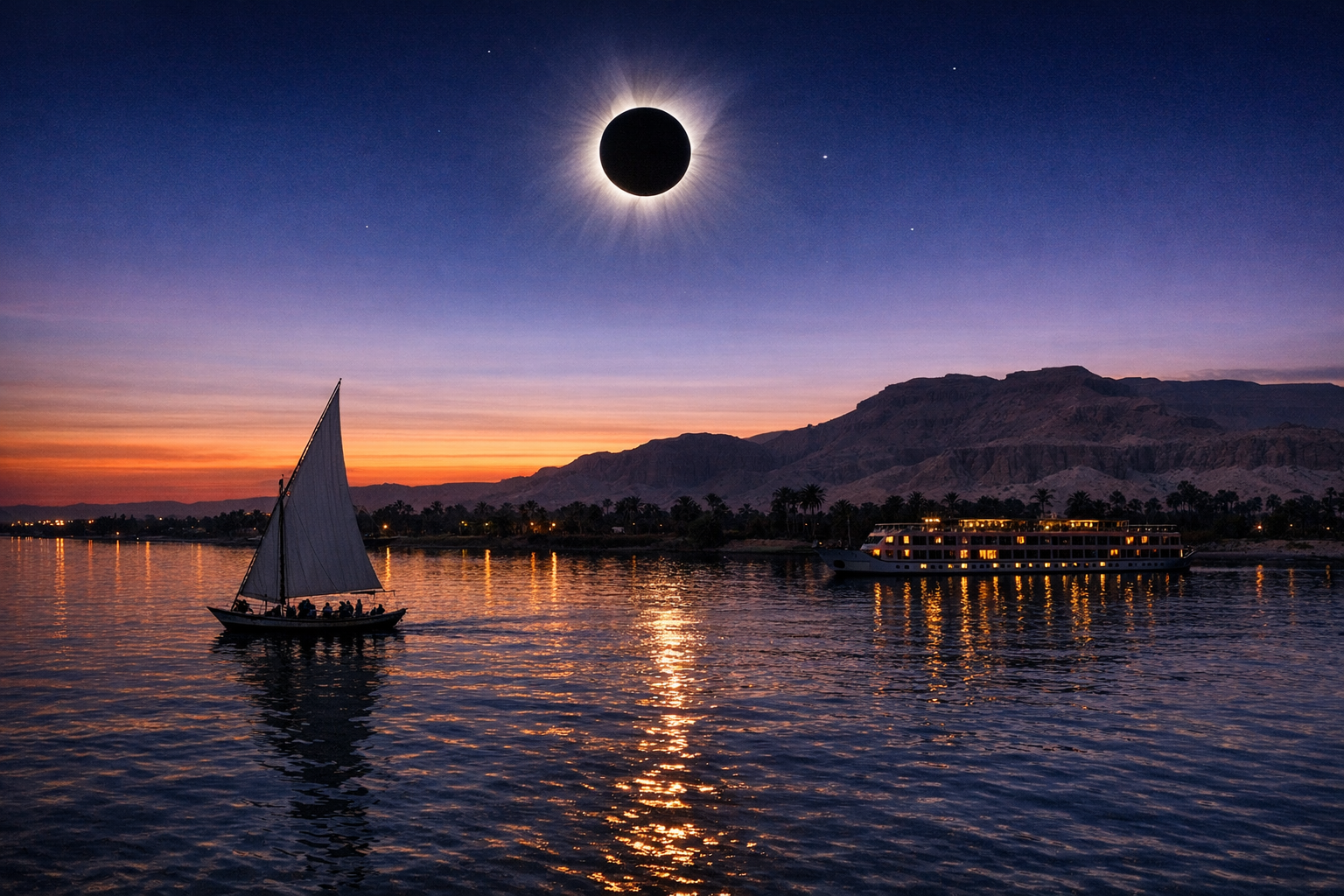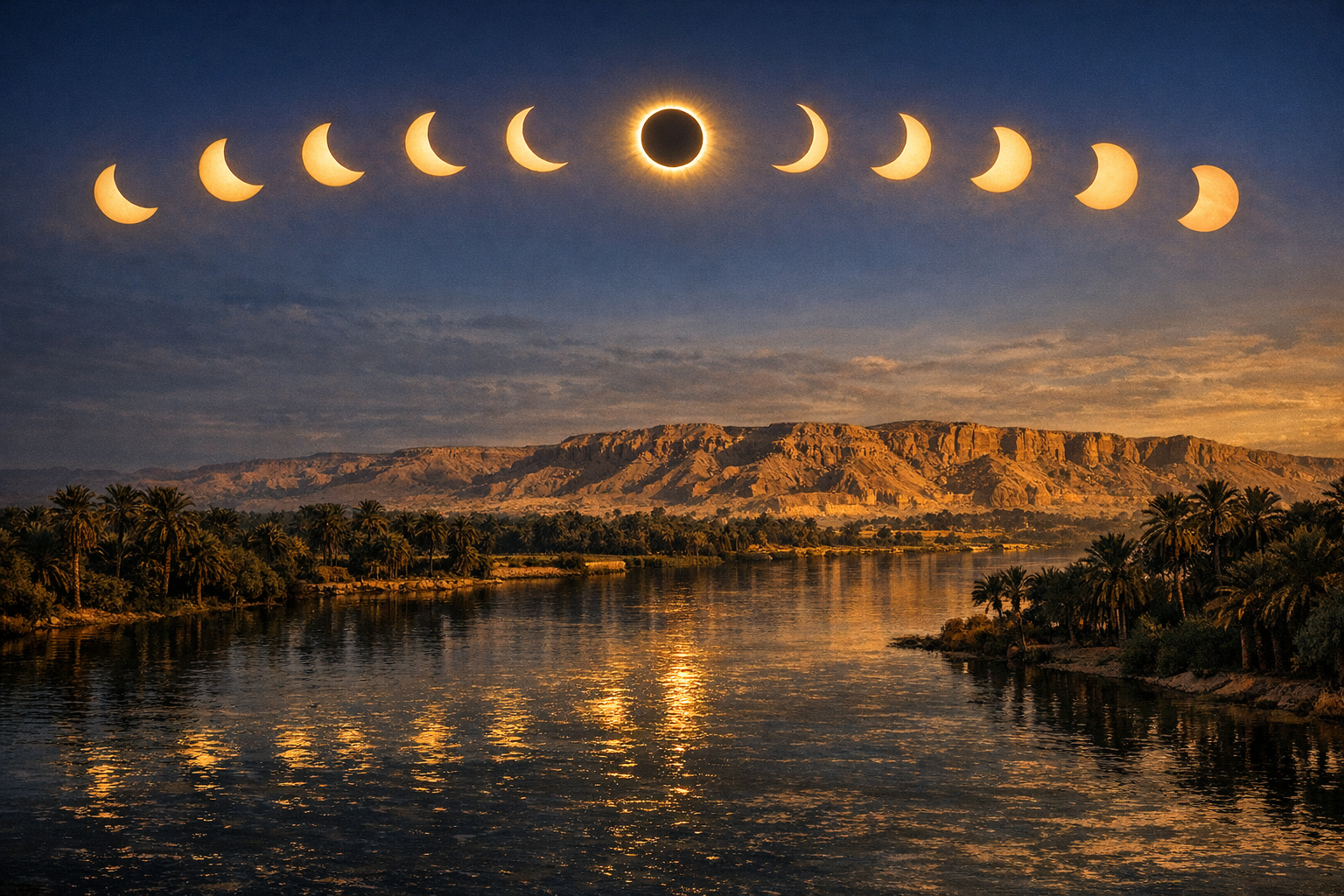
If you are searching for the exact eclipse time in your city, start here: totality reaches Luxor at 13:02 local time on Monday 2 August 2027 and lasts 6 minutes 22 seconds.
That one line explains why travellers from all over the world are already planning to be in Upper Egypt on that Monday afternoon. The path of totality sweeps across Egypt from the Western Desert to the Red Sea coast, and this is the second-longest total solar eclipse of the 21st century. Where you stand matters more than anything else you decide about the trip: a few dozen kilometres can be the difference between a once-in-a-lifetime experience and a slightly dim afternoon.
Cities in the path of totality (with exact times)
All times below are Egypt local time on Monday 2 August 2027. "Partial begins" is the moment the Moon first touches the Sun; totality is the only phase during which the sky goes dark and the corona appears.
- Luxor — partial begins 11:40:21, totality 13:02:14 to 13:08:36, maximum 13:05:26, partial ends 14:26:44. Totality lasts 6 minutes 22 seconds.
- Nag Hammadi — partial begins 11:39:03, totality 13:00:46 to 13:07:10, maximum 13:03:58, partial ends 14:25:20. Totality lasts 6 minutes 24 seconds.
- Sohag — partial begins 11:37:14, totality 12:58:46 to 13:05:09, maximum 13:01:58, partial ends 14:23:29. Totality lasts 6 minutes 23 seconds.
- Qena — partial begins 11:39:52, totality 13:01:34 to 13:07:46, maximum 13:04:41, partial ends 14:25:50. Totality lasts 6 minutes 12 seconds.
- Asyut — partial begins 11:35:37, totality 12:57:03 to 13:03:10, maximum 13:00:06, partial ends 14:21:41. Totality lasts 6 minutes 7 seconds.
- Minya — partial begins 11:33:43, totality 12:55:36 to 12:59:51, maximum 12:57:44, partial ends 14:19:10. Totality lasts 4 minutes 15 seconds.
- Siwa Oasis — partial begins 11:22:18, totality 12:42:42 to 12:48:15, maximum 12:45:28, partial ends 14:08:17. Totality lasts 5 minutes 33 seconds.
- Marsa Alam (Red Sea) — approximately 5 minutes 28 seconds of totality.
- El Quseir (Red Sea) — approximately 5 minutes of totality.
Notice how early the eclipse runs in the far west: Siwa Oasis sees totality a full twenty minutes before Luxor, because the Moon's shadow races across the country from west to east. Wherever you are, be in position and looking up well before the start of totality, because the whole event is over in minutes.
Cairo and Aswan: partial eclipse only
This is the part most search results get wrong, so it is worth stating plainly. Cairo is not in the path of totality. From the capital the partial eclipse begins at 11:33:15, reaches maximum at 12:56:00 and ends at 14:16:24, with maximum coverage of 94.79 percent. The Sun will never fully disappear from Cairo, not even for a second.
Aswan is not in the path either. The city sits just outside the western edge of the path, which means a very deep partial eclipse and no totality at all. For a destination so strongly associated with the Sun, it is a cruel near miss — and a reminder that being close to the path is not the same as being inside it.
If you are already booked into Cairo or Aswan for that week, the fix is simple: plan to be in Luxor, Qena or Sohag on the morning of 2 August, then continue your itinerary afterwards.
Why 95 percent is not good enough
A 94.79 percent partial eclipse sounds like almost the whole thing. It is not. The difference between 95 percent and 100 percent is not a difference of degree, it is a difference of kind.
During a deep partial eclipse the light turns strange and metallic, the air cools, and shadows sharpen. That is genuinely interesting. But the Sun stays painfully bright, you must keep eclipse glasses on for every single second, and the sky stays blue. The remaining sliver of photosphere is still thousands of times brighter than the corona.
Inside the path of totality, something completely different happens. The last bead of sunlight vanishes, the glasses come off, and the Sun's corona appears as a silver halo around a black disc. Stars and planets come out, the horizon glows with a 360-degree sunset, temperature drops, and birds settle. Only inside that narrow band do you see the corona and true darkness.
That is the whole argument for travelling to Luxor rather than staying in Cairo or Aswan: 95 percent gives you a curiosity, 100 percent gives you the experience people describe for the rest of their lives.
Where the longest totality happens
The greatest duration anywhere on Earth — 6 minutes 22 seconds — falls about 60 km (37 miles) southeast of Luxor. The centreline of the path passes roughly 8 km (5 miles) north of Luxor city, which is why Luxor and its surroundings are the prime viewing region for this eclipse.
In practice, anywhere between Sohag and Luxor delivers well over six minutes of totality, and the differences of a few seconds between Qena, Nag Hammadi and Luxor matter far less than clear skies, an unobstructed horizon and getting to your site early. Early August in Upper Egypt is reliably cloud-free, which is exactly why eclipse chasers have had this date circled for years.
Want more detail before you commit? Read our full guide to the 2027 total solar eclipse in Luxor, compare the best places to watch the 2027 eclipse in Egypt, and check the eclipse safety and solar glasses guide before you buy any viewing equipment.
Book your Luxor eclipse trip with FreeGo
The eclipse lasts minutes; the planning takes months. Accommodation and transport in Luxor, Qena and Sohag for 2 August 2027 are already in heavy demand, and the closer the date gets, the harder it becomes to place groups inside the path on the morning itself.
FreeGo Travel Agency builds Luxor eclipse itineraries around one priority: putting you in the path of totality, in position, with time to spare. Talk to our team about dates, viewing sites and adding the temples, the Valley of the Kings and the Nile to your trip — and make sure that on Monday 2 August 2027 at 13:02 you are standing in the shadow, not looking at it from 95 percent away.