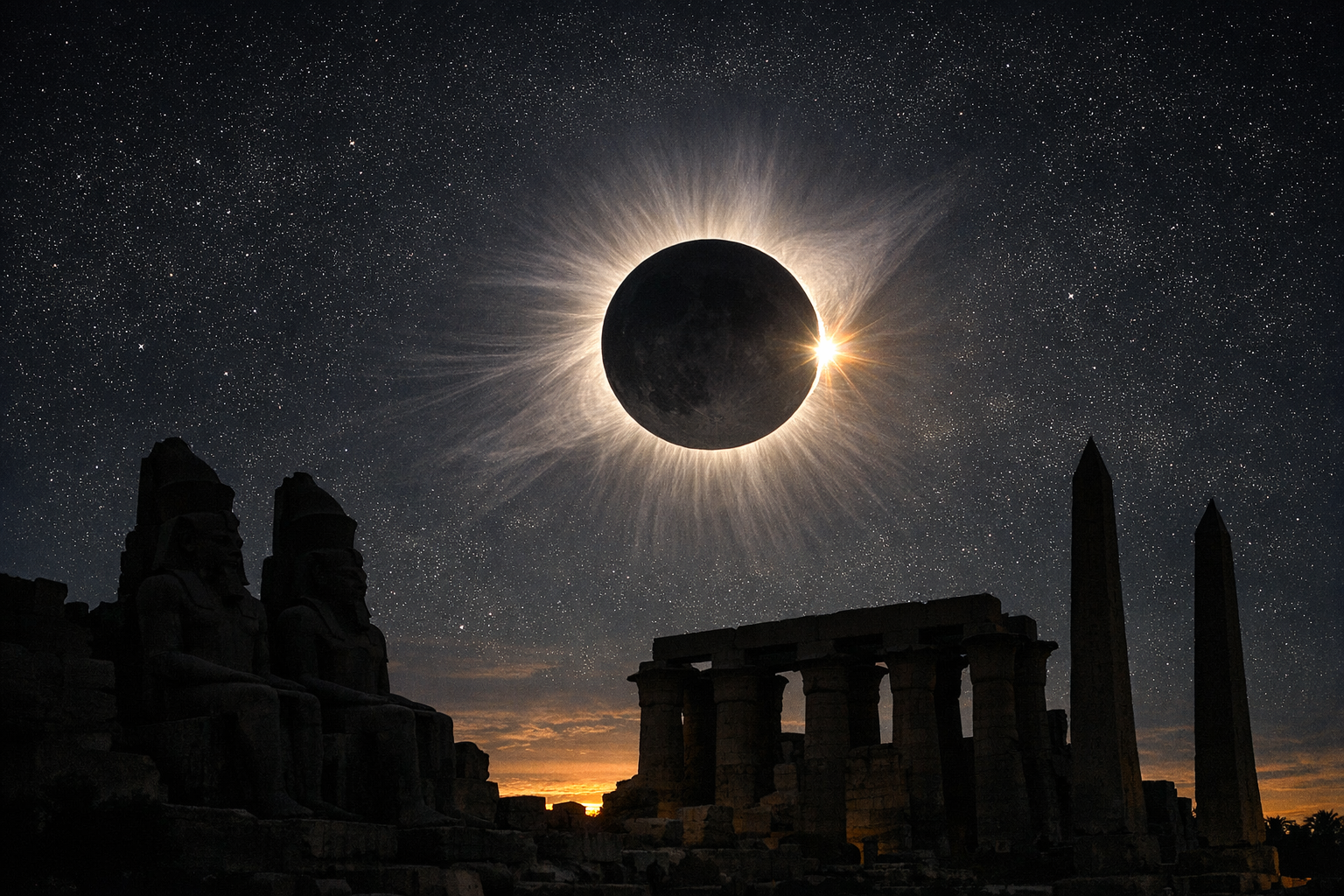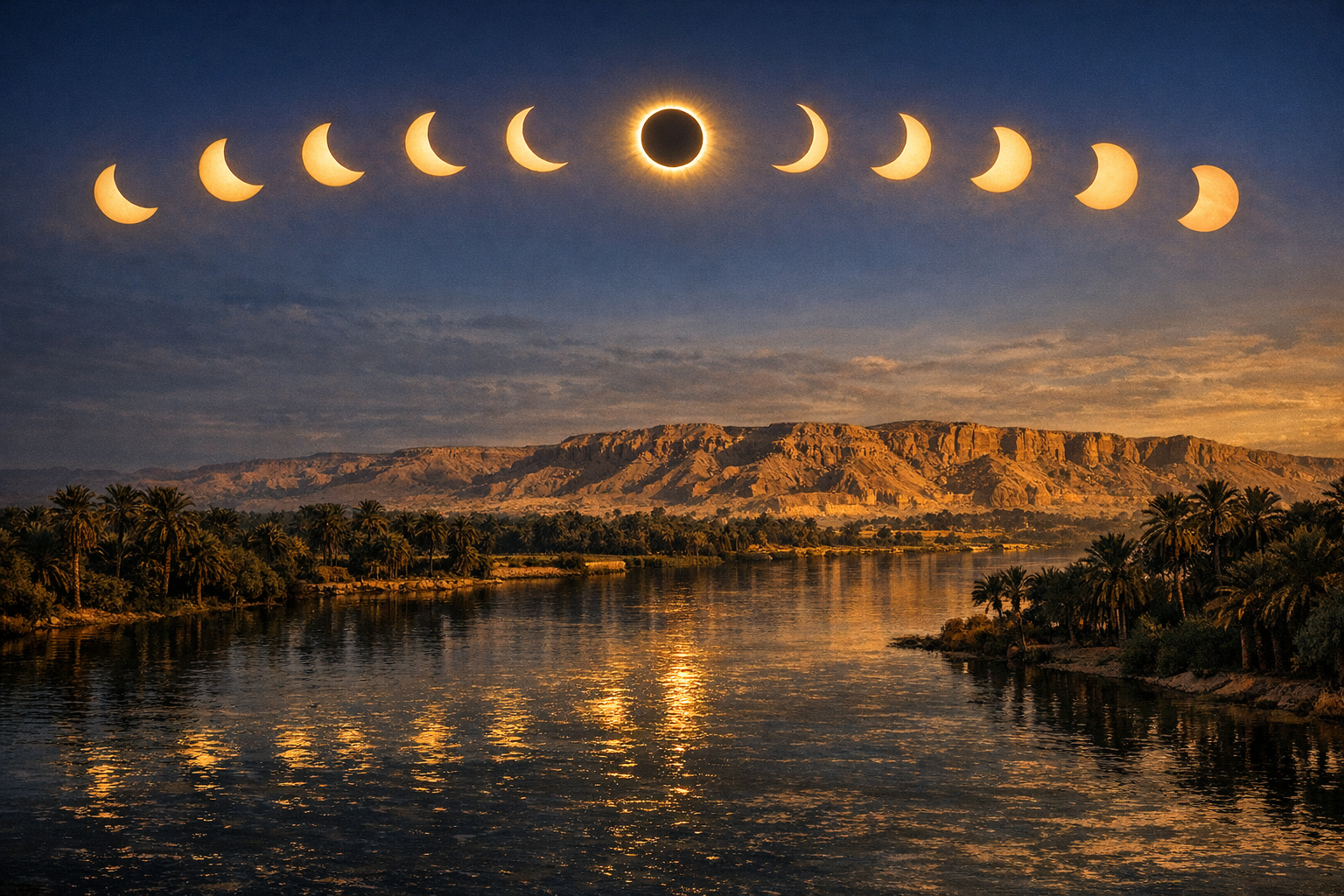
On Monday 2 August 2027, the Moon's shadow will sweep across Egypt and switch off the sun over the Nile Valley. This is the second-longest total solar eclipse of the 21st century, and the single best place on the planet to stand is in Egypt: the point of greatest duration, 6 minutes and 22 seconds of totality, falls roughly 60 km (37 miles) southeast of Luxor.
That makes choosing where to watch unusually important. A few hundred kilometres can be the difference between six minutes of darkness and no totality at all. Below are the best places to watch the 2027 solar eclipse in Egypt, ranked by how much totality you get, how reliable the sky is, and how easy the location is to reach.
1. Luxor and the desert centreline southeast of it
Best for: the longest totality on Earth combined with world-class monuments.
Luxor is the clear winner. The city sits essentially on the centreline — the line itself passes about 8 km (5 miles) north of Luxor — and the city receives the full 6 minutes and 22 seconds of totality. Karnak Temple, Luxor Temple, the Valley of the Kings and the whole West Bank all lie inside the path of totality, so you can watch the sun disappear from among monuments built by people who worshipped it.
If you want to chase the maximum, head into the open desert southeast of the city, where the point of greatest duration anywhere on Earth falls about 60 km (37 miles) away. Our full guide to the 2027 eclipse in Luxor goes deeper on the city and its surroundings.
2. A Nile cruise inside the path
Best for: flexible positioning and an uninterrupted horizon.
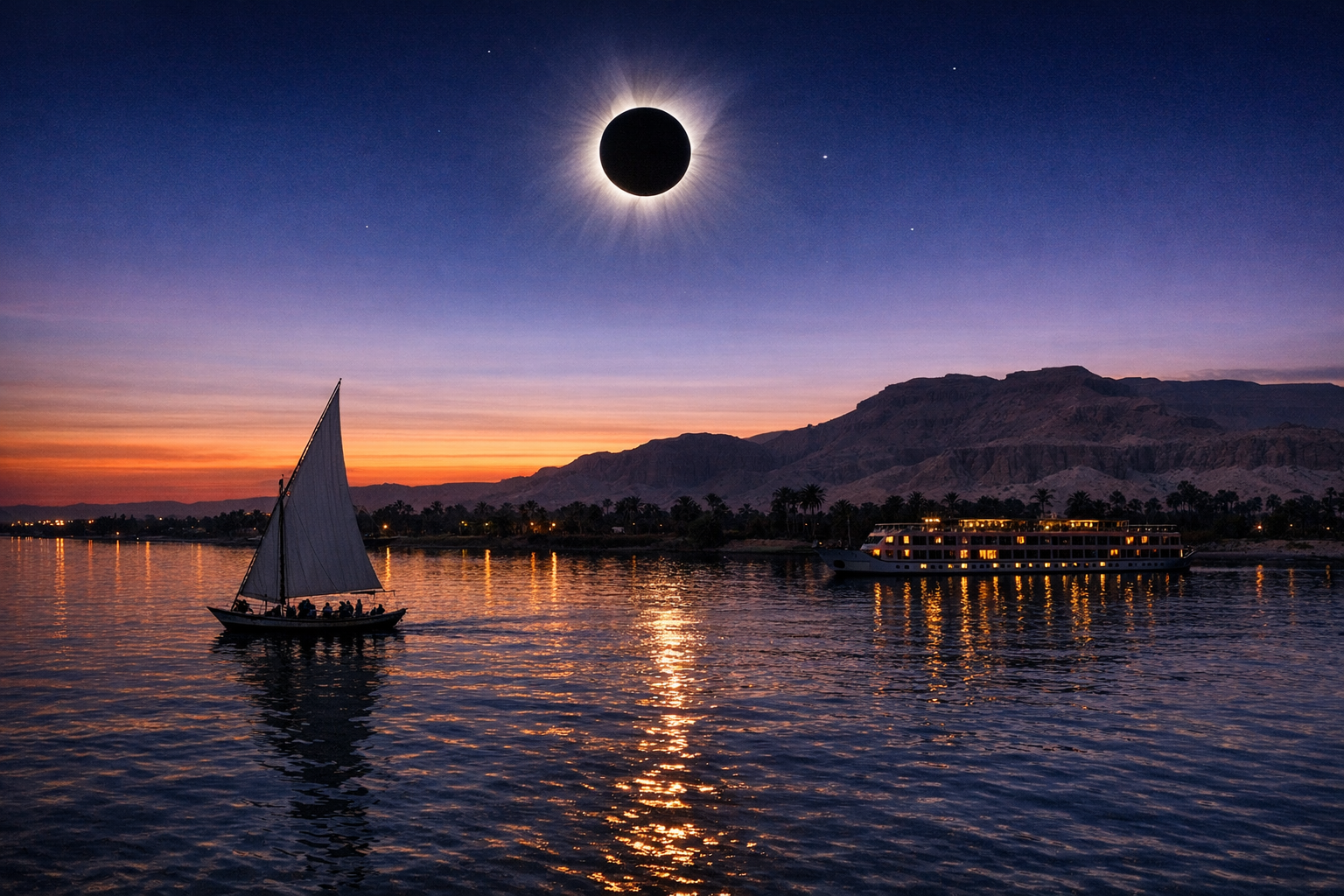
The stretch of the Nile between Luxor and the Qena and Nag Hammadi area sits inside the path of totality, which makes the river itself a viable viewing platform. A cruise lets you watch from an open sun deck with a clear view in every direction, away from crowds, and it turns eclipse day into part of a longer journey through Upper Egypt rather than a single appointment with the sky.
3. Marsa Alam and the Red Sea coast
Best for: combining totality with beach and diving time.
Marsa Alam sits inside the path and gets about 5 minutes and 28 seconds of totality — shorter than Luxor, but still an extraordinary stretch of time under the shadow. Further north along the coast, El Quseir receives around 5 minutes. The appeal here is the sea horizon and the resort infrastructure: you can watch the eclipse in the morning and be in the water the same afternoon. It also pairs easily with a few days in Luxor if you want both.
4. Sohag, Qena, Nag Hammadi and Asyut
Best for: travellers chasing maximum duration away from the crowds.
Several Middle and Upper Egyptian towns sit squarely inside the path and rival Luxor on raw numbers. Nag Hammadi gets 6 minutes and 24 seconds, Sohag 6 minutes and 23 seconds, Qena 6 minutes and 12 seconds, and Asyut 6 minutes and 7 seconds. Minya, further north, still manages 4 minutes and 15 seconds. These are working Egyptian towns rather than tourist centres, so they offer far less visitor infrastructure than Luxor — but for duration per crowd they are hard to beat. See our city-by-city eclipse times for the full breakdown.
5. Siwa Oasis
Best for: desert scenery and a completely different side of Egypt.
Siwa, out towards the Libyan border, lies inside the path and receives 5 minutes and 33 seconds of totality. It offers something no other site on this list can: palm groves, salt lakes and the Great Sand Sea as a backdrop, far from the Nile Valley. The trade-off is distance, so Siwa suits travellers who want the oasis as a destination in its own right rather than simply as a viewpoint.
6. Cairo and Aswan — partial eclipse only
Best for: travellers who genuinely cannot leave the capital or the far south.
Cairo sees a 94.79 percent partial eclipse. That sounds close, but a deep partial is not a total eclipse: the corona never appears, the sky does not go dark, and the experience is a fraction of what happens a few hundred kilometres south. Aswan sits just outside the western edge of the path and also gets a deep partial only, which surprises many visitors who assume all of Upper Egypt is covered. If you are in Egypt on 2 August 2027, it is worth travelling to get inside the path.
Quick comparison
- Nag Hammadi — 6 min 24 s
- Sohag — 6 min 23 s
- Luxor — 6 min 22 s
- Qena — 6 min 12 s
- Asyut — 6 min 7 s
- Siwa Oasis — 5 min 33 s
- Marsa Alam — about 5 min 28 s
- El Quseir — about 5 minutes
- Minya — 4 min 15 s
- Cairo — 94.79 percent partial only
- Aswan — deep partial only
The greatest duration anywhere on Earth, 6 minutes and 22 seconds, falls about 60 km (37 miles) southeast of Luxor.
August weather: clear skies, serious heat
The reason Egypt tops almost every 2027 eclipse shortlist is not only geometry — it is climate. August in Luxor brings famously clear, nearly cloud-free skies, which makes Egypt one of the best viewing climates on the whole eclipse track. Cloud is the one thing that can ruin an eclipse trip, and here the odds sit firmly in your favour.
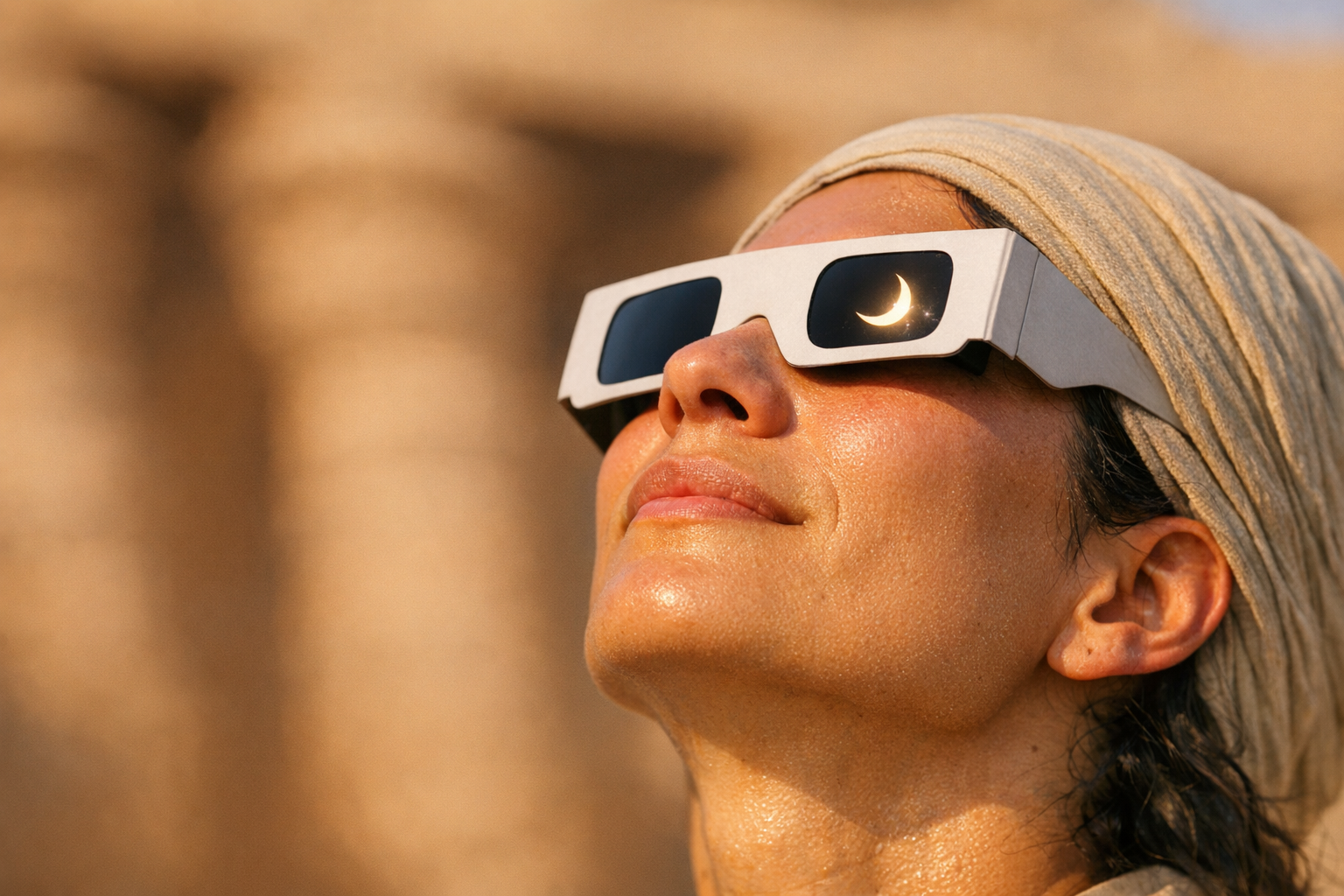
The cost is heat. Average highs in Luxor in August are around 42°C. Plan for early starts, shade, loose clothing and more water than you think you need, and treat the middle of the day with respect. Certified solar filters are essential right up until totality begins.
Watch the 2027 eclipse with FreeGo
A total solar eclipse returns to any one given place roughly once every 400 years, so 2 August 2027 is effectively a once-in-many-lifetimes appointment for the Nile Valley. Accommodation inside the path of totality is finite, and Luxor is the most in-demand spot on Earth for this event.
FreeGo Travel Agency arranges eclipse-day viewing, transfers and stays along the centreline. Explore our total solar eclipse 2027 Luxor tour and secure your place in the shadow.