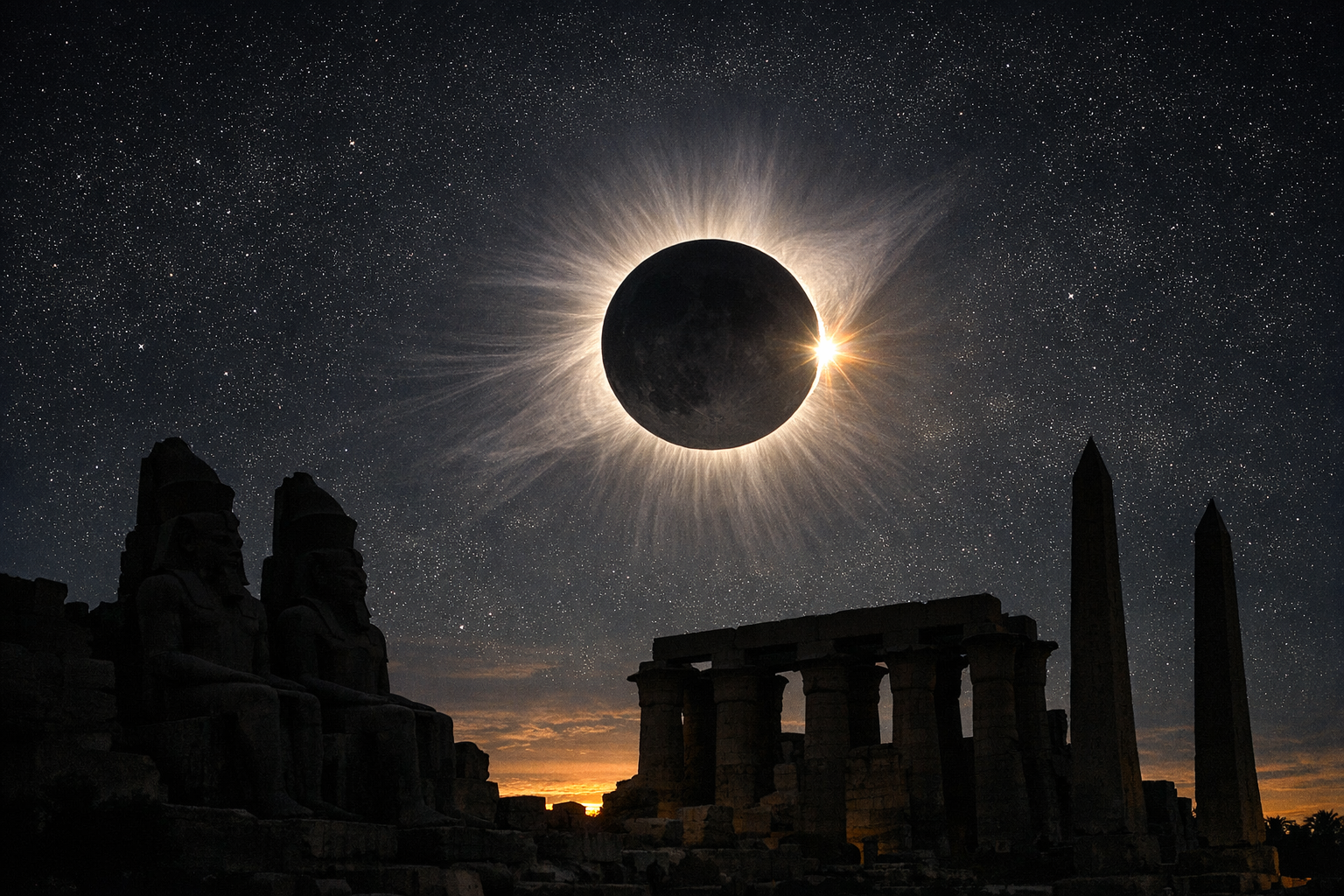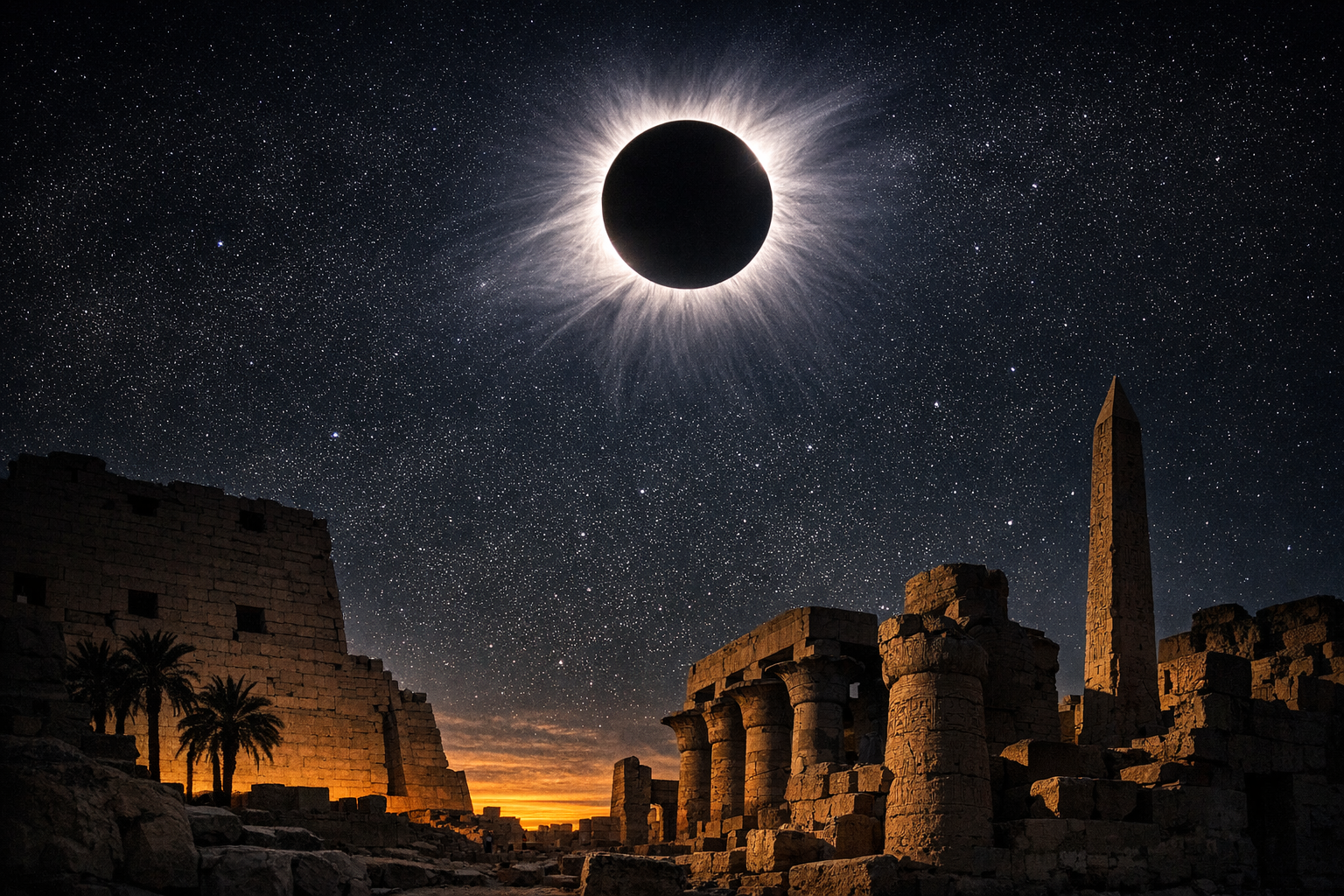
Just after one o'clock in the afternoon, the light over Luxor will begin to drain away. The colonnades of Karnak will cool. The Colossi of Memnon will lose their shadows. Birds along the Nile will fall silent, the air temperature will drop, and for six minutes and twenty-two seconds the sky above the Valley of the Kings will turn to night — stars, planets and the sun's silver corona suspended over three-thousand-year-old stone.
This is the total solar eclipse of Monday, 2 August 2027, and nowhere on Earth will see it better than Egypt.
What happens on August 2, 2027
A total solar eclipse occurs when the moon passes directly between the Earth and the sun, covering the solar disc completely and dragging a narrow band of shadow — the path of totality — across the surface of the planet. On 2 August 2027 that path sweeps across Spain, Gibraltar, Morocco, Algeria, Tunisia, Libya, Egypt, Saudi Arabia, Yemen and Somalia.
Egypt sits at the very heart of it. The point of greatest eclipse — where totality lasts longer than anywhere else on Earth — falls roughly 60 km (37 miles) southeast of Luxor, where the moon's shadow lingers for 6 minutes and 22 seconds. It is the second-longest total solar eclipse of the entire 21st century, and Upper Egypt is its stage.
For perspective: a total solar eclipse is visible from any one given place only about once every 400 years. This is not an event you reschedule.
Exact eclipse times in Luxor
All times below are local to Luxor on Monday, 2 August 2027:
- Partial eclipse begins — 11:40
- Totality begins — 13:02
- Maximum eclipse — 13:05
- Totality ends — 13:08
- Partial eclipse ends — 14:26
- Duration of totality at Luxor — 6 minutes 22 seconds
The full spectacle unfolds over nearly three hours, but the part that changes people — true darkness at midday — lasts just over six minutes. Being in position, settled and ready well before 13:02 is the single most important decision of the day.
Why Egypt is the best place on Earth to watch it
Eclipse chasers judge a location on two things: how long totality lasts, and whether the sky will be clear. Egypt wins on both counts, which is why the August 2 2027 eclipse has been circled on calendars for years.
- Maximum duration. The centreline passes within about 60 km southeast of Luxor, delivering the longest totality available anywhere along the path.
- Famously clear skies. August in Upper Egypt is reliably cloud-free, removing the single greatest risk in eclipse travel — a sky that closes over at the wrong moment.
- Stable desert air. Average highs of around 42°C come with dry, settled conditions and exceptional visibility right down to the horizon.
- An incomparable setting. Temples, tombs and the Nile sit directly beneath the path, giving the eclipse a backdrop no other country on the route can offer.
Travellers will watch this eclipse from beaches, city squares and mountain passes across three continents. Only in Egypt will they watch it standing beside monuments that were built, thousands of years ago, to track the sun.
Where to watch from
If you are deciding where to see the 2027 eclipse, a handful of places in Egypt stand out:
- Luxor and the land immediately southeast of the city — the closest you can comfortably get to the point of greatest duration.
- The West Bank — open desert ground near the Theban necropolis, with long clean sightlines and almost no interference from city light or buildings.
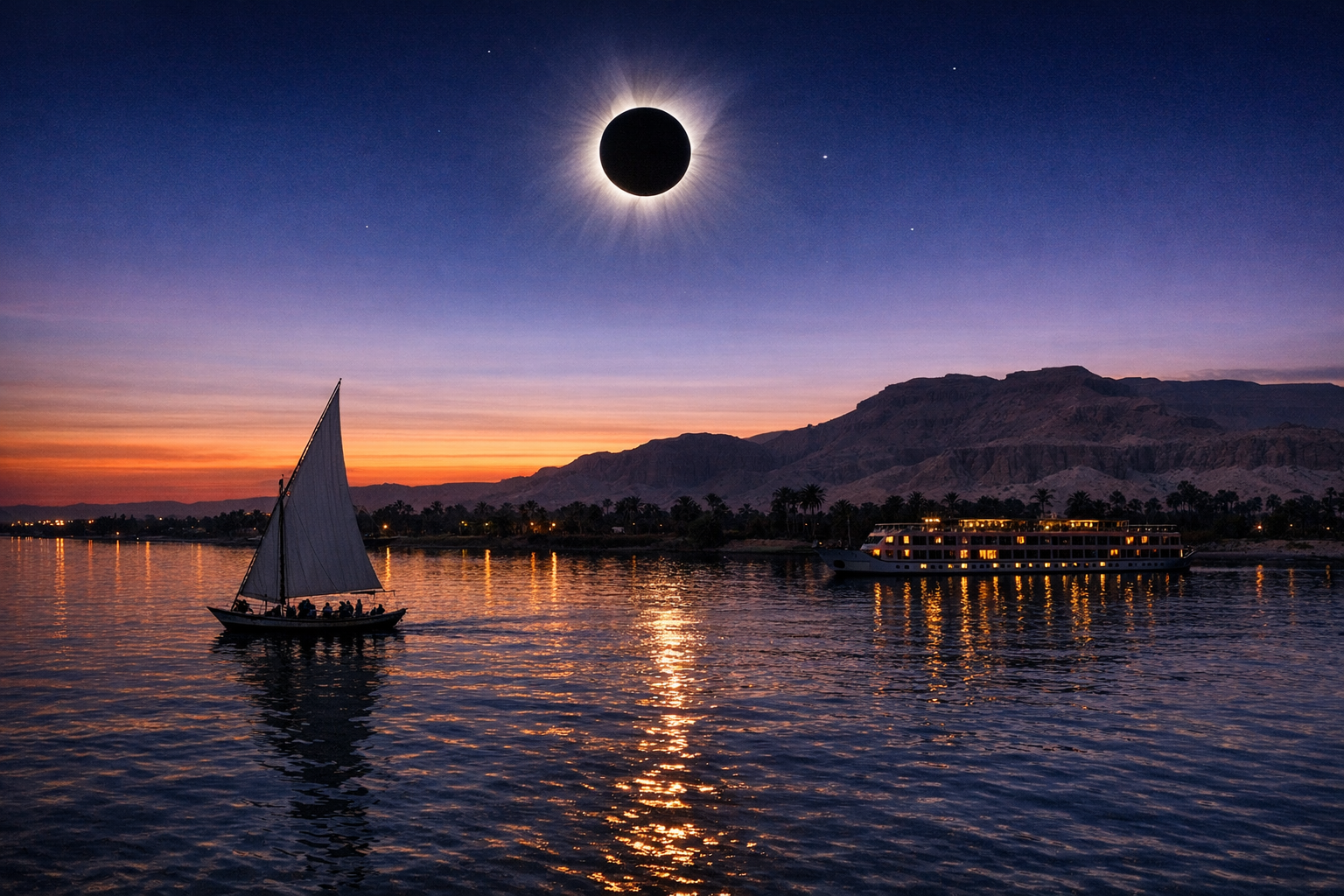
- The Nile itself — the deck of a cruise vessel offers an uninterrupted horizon and the extraordinary sight of the river darkening around you.
- Upper Egypt more widely — totality is visible across a broad band, with quieter vantage points away from the main crowds.
- The Red Sea coast area — a natural pairing for travellers who want coastal days either side of the eclipse.
Wherever you choose, the difference between a full 6 minutes 22 seconds and a noticeably shorter view can come down to a few dozen kilometres. Position matters more than almost anything else.
How to prepare
Protect your eyes
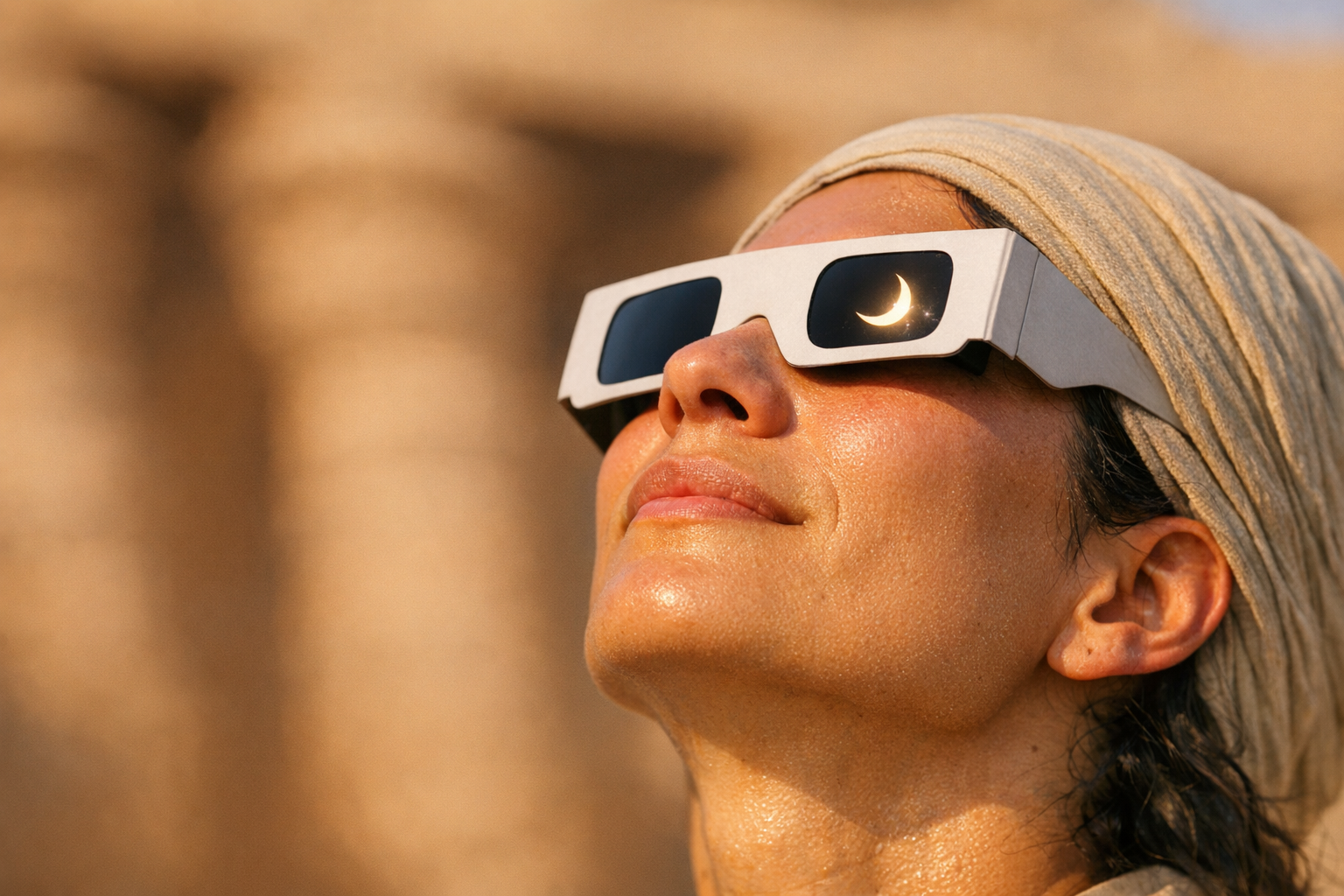
Use only certified ISO 12312-2 eclipse glasses, and bring spares. Never look at the sun without them. The one exception is totality itself: once the solar disc is completely covered, the glasses come off — and the instant the first bead of light returns, they go straight back on. Sunglasses, exposed film and smoked glass offer no protection whatsoever.
Plan for 42°C
August highs in Luxor average around 42°C, and you will be standing outdoors through the middle of the day. Carry considerably more water than you think you need, wear light long sleeves and a wide-brimmed hat, use shade between the partial phases, and keep the rest of the day deliberately unhurried.
Arrive a day or two early
Roads near the centreline will be busy and the eclipse will not wait. Arriving 48 hours ahead lets you acclimatise to the heat, scout and confirm your viewing spot, rehearse the timings, and absorb any delay without losing the moment altogether.
Cameras and phones
- A proper solar filter is essential for any lens pointed at the partial phases.
- Set up and test every piece of equipment the day before, not on the morning itself.
- Spend at least half of totality simply looking — the corona does not photograph the way it feels.
- Leave a wide shot running to capture the landscape, and the people around you, going dark.
Book early: why 2027 hotels and tours sell out years in advance
Eclipse travel does not behave like ordinary travel. A global community of eclipse chasers plans years ahead, and an Egypt eclipse tour on 2 August 2027 is among the most sought-after travel dates of the decade.
- Luxor's hotel capacity is finite, and eclipse week concentrates worldwide demand into a single location.
- Nile cruise cabins are limited in number and are typically the first thing to disappear.
- Guides, drivers and private transfers close to the centreline are reserved far in advance.
- Flights into Egypt around the eclipse window tighten steadily as the date approaches.
Demand for eclipse Luxor 2027 is not speculative — it is already building. Reserving early is less a question of price than of being there at all.
Frequently asked questions
When is the total solar eclipse in Egypt?
The total solar eclipse falls on Monday 2 August 2027. It is a single-day event, and the whole of the experience in Egypt — partial phases included — unfolds within a few hours of that one afternoon, so travel plans need to be built around that exact date.
What time is totality in Luxor?
In Luxor, totality runs from 13:02:14 to 13:08:36 Egypt local time, with maximum eclipse at 13:05:26. The partial phases frame it either side, beginning at 11:40:21 and ending at 14:26:44. Be in position and settled well before the first of those totality timings.
How long does totality last?
Totality lasts 6 minutes 22 seconds in Luxor. The greatest duration on Earth falls about 60 km southeast of the city, so the closer you stand to that point, the longer the darkness. A difference of a few dozen kilometres is enough to shorten what you see.
Will Cairo see the total eclipse?
No. Cairo lies outside the path of totality and will see a 94.79 percent partial eclipse only. That is a striking sight in itself, but the sky does not go fully dark and the corona never appears. For totality you need to travel south to Upper Egypt.
Will Aswan see totality?
No. Aswan sits just outside the western edge of the path and will see a deep partial eclipse only. It is close enough to be tempting, but close is not enough: without crossing into the path you miss totality altogether. Luxor and the ground southeast of it remain the better base.
Is it safe to look at the sun?
Only through ISO 12312-2 certified eclipse glasses during the partial phases. The naked eye is safe for the brief minutes of totality alone, once the solar disc is completely covered. The moment the first light returns, the glasses go straight back on and stay on until the end.
Should I book now?
Yes. Hotel capacity in Luxor and cabin space on Nile cruises for early August 2027 are limited, and both sell out years ahead of the date. Booking early is less a question of securing a better rate than of securing a place near the centreline at all.
Keep reading
- Compare exact eclipse times for every Egyptian city before fixing your location.
- Weigh up the best places in Egypt to watch the eclipse, from desert ground to the river.
- Read our guide to how to watch the eclipse safely.
- Browse the full 2027 eclipse FAQ for the practical detail.
- See our 5-day Luxor eclipse tour, built around the centreline.
- Or watch from the water with our 8-day eclipse Nile cruise.
Reserve your place for 2 August 2027
FreeGo Travel Agency arranges eclipse travel across Egypt: Luxor stays, Nile cruises and Upper Egypt itineraries built around the exact moment the shadow arrives. Tell our team where you want to be standing at 13:02 on Monday, 2 August 2027, and we will build the journey around it.
Contact FreeGo Travel Agency to begin planning. The next one here is roughly four hundred years away.